


Carburants

Aider les autorités publiques à contrôler la chaîne d’approvisionnement des carburants
La protection des carburants repose sur un marquage fiable et des contrôles rigoureux. La présence, même en faible quantité, de composants non réglementés dans leur composition peut entraîner de lourdes conséquences sur les plans technique, économique et environnemental. Un carburant de mauvaise qualité endommage les moteurs, augmente les coûts d'exploitation et engendre des risques de pollution et de sécurité.
Dans ce contexte, SICPA a développé une gamme de marqueurs de carburant, qui permet aux autorités publiques de contrôler leur qualité dans les dépôts et stations-service.
De tels programmes de marquage contribuent à garantir que les carburants sont sûrs, conformes à la réglementation et sans danger pour l’environnement ou la santé des citoyens.

La Solution d’intégrité des carburants (FIS) de SICPA contribue à la protection de l’environnement en détectant les carburants non conformes
Les marqueurs de SICPA contribuent à préserver l’intégrité des carburants et à promouvoir des pratiques conformes aux réglementations en donnant aux autorités publiques les moyens de détecter les cas de détournement, de falsification, ainsi que les mélanges illégaux tout au long de la chaîne d’approvisionnement des carburants. Les marqueurs sont conçus pour être ajoutés à l’état de trace. Ils n’altèrent pas les performances des carburants, et ne présentent aucun risque pour les utilisateurs ou l’environnement lors de leur combustion.
SICPA assure la gestion de ces produits conformément aux cadres réglementaires applicables et à ses obligations en matière de responsabilité des produits :
- Enregistrement au titre du règlement européen REACH (règlement [CE] n° 1907/2006 du Parlement européen et du Conseil, adopté le 18 décembre 2006), après réalisation d’analyses physico-chimiques, toxicologiques et écotoxicologiques par des laboratoires indépendants reconnus;
- Respect des exigences suisses en matière de notification;
- Respect des réglementations locales dans les pays où SICPA exerce ses activités.
Nos pratiques reposent sur des données physico-chimiques, toxicologiques et écotoxicologiques rigoureuses. Les enjeux liés à la santé au travail et à l’environnement sont pris en compte dans le cadre d’une démarche incluant la classification des dangers, l’évaluation des risques, des recommandations pour une manipulation sûre par les utilisateurs professionnels et l’analyse des potentiels impacts environnementaux tout au long du cycle de vie. Des analyses indépendantes menées dans des conditions réelles d’utilisation ont confirmé que le marquage des carburants n’entraîne pas d’augmentation des émissions de polluants organiques persistants (POP) réglementés par rapport aux carburants non marqués.
La teneur en soufre des carburants constitue un facteur déterminant de la pollution atmosphérique, non seulement en raison de ses effets nocifs directs sur la santé humaine, mais également parce qu’elle dégrade et réduit l’efficacité des technologies de contrôle des émissions équipant les véhicules. Tant que la teneur en soufre des carburants sera élevée, les efforts visant à réduire la pollution atmosphérique, notamment par la modernisation du parc automobile, resteront limités et ne pourront atteindre pleinement leurs objectifs. La technologie de marquage des carburants de SICPA est la seule solution sur le marché permettant, grâce à un seul test réalisé sur site en moins de cinq minutes, de vérifier à la fois la conformité fiscale des carburants (grâce au marqueur) et leur qualité (teneur en soufre).

Protéger l’intégrité des carburants et les recettes publiques
Dans la lutte contre la falsification, la contrebande et les activités illicites liées aux carburants, SICPA soutient les autorités grâce à une solution éprouvée permettant de préserver les recettes fiscales, de protéger la qualité des carburants et de garantir l’intégrité de leur chaîne d’approvisionnement.
Les autorités publiques et les compagnies pétrolières peuvent suivre et contrôler efficacement la distribution des produits hydrocarbures en s’appuyant sur des technologies de marquage robustes, associées à une plateforme de suivi des données. Ces outils renforcent l'action des forces de l’ordre et contribuent à la mise en œuvre de politiques visant à associer pleinement les citoyens au développement d’une économie légale.

Analyses indépendantes réalisées par des organismes et laboratoires accrédités selon la norme ISO 1702, conformément à la Convention de Stockholm


L'Agence européenne des produits chimiques (ECHA) est l'autorité de référence de l'Union européenne en matière de sécurité chimique. Elle apporte son expertise scientifique et garantit le respect des normes afin de protéger la santé humaine et l’environnement. Grâce à son rôle dans la mise en œuvre de règlements européens majeurs tels que le REACH et le CLP, l’ECHA veille à ce que les risques liés aux substances chimiques soient identifiés, évalués et maîtrisés de manière transparente, sur la base de données scientifiques. En établissant des normes strictes en matière d'évaluation des dangers, de gestion des risques et de communication au sein de la chaîne d'approvisionnement, l'ECHA s'est imposée comme une référence mondiale en matière de réglementation. Elle garantit ainsi que les substances chimiques mises sur le marché peuvent être utilisées en toute sécurité, tout en favorisant l’innovation, la durabilité et la confiance du public.

Eurofins Scientific est le leader mondial en matière de détection des dioxines et des polluants organiques persistants (POP), avec plus de 15 000 échantillons analysés chaque année. Le Centre de compétence Eurofins spécialisé dans les dioxines et les polluants organiques persistants a mené des analyses indépendantes sur les marqueurs de carburant de SICPA afin d'évaluer leur impact sur l'environnement et la santé publique. Les émissions de polychlorodibenzo-p-dioxines et de polychlorodibenzofuranes (PCDD/PCDF), de polychlorobiphényles (PCB), de polybromodibenzo-p-dioxines et de polybromodibenzofuranes (PBDD/PBDF), ainsi que de polybromobiphényles (PBB), ont été mesurées sur des carburants marqués et non marqués. Les résultats confirment que les marqueurs FIS de SICPA ne présentent aucun risque pour l'environnement ni pour la santé publique, et qu'ils sont pleinement conformes aux normes réglementaires internationales.

SOCOTEC est un leader mondial des services de Testing, Inspection et Certification (TIC) et accompagne les autorités et les entreprises dans l’évaluation de la sécurité, des performances environnementales et de la conformité réglementaire des produits. Dans le cadre de son approche de gestion responsable des produits et de diligence environnementale, SICPA a mandaté SOCOTEC, dont le laboratoire basé à Manchester est accrédité ISO/IEC 17025 et certifié MCERTS par l’UKAS, pour réaliser des tests indépendants sur les émissions, portant sur l’ensemble des substances concernées. Ces analyses indépendantes ont confirmé que le marquage des carburants n’entraîne aucune augmentation des émissions de POP réglementés ni d’autres polluants soumis à contrôle par rapport aux carburants non marqués. Elles apportent ainsi des preuves scientifiques supplémentaires confirmant que la solution FIS de SICPA ne présente aucun risque pour l’environnement.

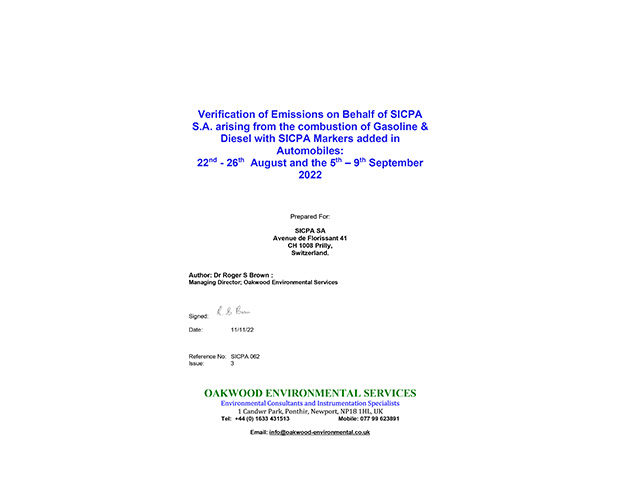
La campagne d’analyse des marqueurs de SICPA a été menée sous la supervision du Dr Roger S. Brown, un scientifique de renommée internationale spécialisé dans la qualité de l’air, président de la Source Testing Association (STA) au Royaume-Uni et Fellow de la Royal Society of Chemistry (FRSC). La Source Testing Association fait figure de référence dans le domaine de la surveillance des émissions depuis plus de trente ans. Au fil des années, elle a largement contribué à faire évoluer les normes du secteur et à améliorer la précision, la fiabilité et la sécurité des pratiques de surveillance en lien avec les émissions. En favorisant le partage des bonnes pratiques et le développement des compétences professionnelles, la STA accompagne ses membres en leur fournissant les connaissances et les outils nécessaires pour relever les défis d’un secteur en constante évolution. Les résultats du Dr Roger S. Brown confirment que la solution FIS n’entraîne pas d’augmentation mesurable des polluants atmosphériques réglementés ni des polluants organiques persistants par rapport aux carburants non marqués. Ils établissent ainsi clairement que les marqueurs de SICPA peuvent être utilisés sans compromettre la qualité de l’air, les objectifs de protection de l’environnement ou les exigences en matière de santé publique.

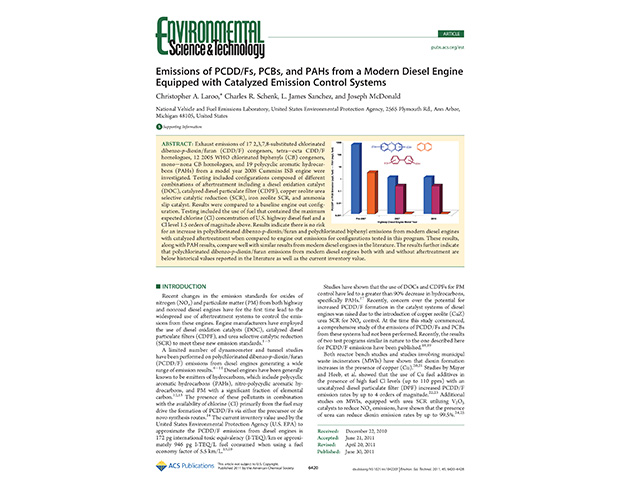
Des études similaires portant sur les émissions de POP liées à la présence de composés halogénés dans les carburants ont également été menées par l’Agence américaine de protection de l’environnement (EPA) et publiées dans des revues scientifiques avec évaluation par les pairs.
« Les analyses ont notamment porté sur l’utilisation d’un carburant présentant la concentration maximale attendue en chlore (Cl) dans le diesel routier américain, ainsi que d’un carburant dont la concentration en chlore était supérieure de 1,5 ordre de grandeur (soit 10 ppm). Les résultats indiquent qu’il n’existe pas de risque d’augmentation des émissions de polychlorodibenzo-p-dioxines/furanes et de polychlorobiphényles provenant de moteurs diesel modernes équipés de systèmes de post-traitement catalytique par rapport aux émissions brutes en sortie moteur pour les configurations testées dans le cadre de ce programme. » (Environ. Sci. Technol. 2011, 45, 6420–6428)
Réalisée en toute indépendance par une agence reconnue telle que l’EPA, cette étude, fondée sur une méthodologie comparable et aboutissant aux mêmes conclusions que les travaux antérieurs, vient renforcer la crédibilité des études rigoureuses menées sur les marqueurs de carburant de SICPA.
Rapports – page de couverture
Oakwood Environmental Services

Oakwood Environmental Services
Environmental Service & Technology


Défis et besoins

Vue d'ensemble de la solution

Des solutions qui profitent à tous

Études de cas
FAQ
La Solution d’intégrité des carburants de SICPA associe le marquage moléculaire des carburants, les inspections sur le terrain et la surveillance des données afin de protéger les chaînes d’approvisionnement en carburant en aval contre la fraude fiscale.
En introduisant des marqueurs moléculaires inaltérables dans certaines qualités de carburant, les autorités peuvent effectuer des tests rapides sur le terrain pour détecter immédiatement les activités suspectes, lutter contre la contrebande et l'adultération, et renforcer le contrôle de la chaîne d'approvisionnement.
Le marquage forensique des carburants fournit une preuve claire de l'identité du produit et soutient le suivi de la conformité dans tout le réseau de distribution, aidant les autorités à vérifier la conformité et à identifier les détournements potentiels de carburants subventionnés.
Une solution nationale visant à garantir l’intégrité des carburants permet de protéger les recettes publiques, de défendre les consommateurs contre les carburants hors spécifications, de réduire au minimum l’impact environnemental et de renforcer la transparence dans l’ensemble du secteur pétrolier en aval.