


Fuel

Empowering public authorities to control the fuel supply chain
Fuel must be properly marked and controlled to ensure its protection. Even small, unregulated components in its composition can lead to serious technical, economic, and environmental consequences. Poor‑quality fuel damages engines, increases operating costs, and aggravates safety and pollution risks.
This is why SICPA has developed a suite of fuel markers, enabling public authorities to control fuel quality in depots and fuel stations.
Such fuel marking programs help ensure that fuels are safe, compliant to applicable regulation, and their impact on the environment and the health of citizens controlled for both the environment and the health of citizens.

SICPA Fuel Integrity Solution (FIS): Supporting environmental protection by preventing substandard fuels
SICPA’s fuel markers support fuel integrity and lawful market practices by enabling public authorities to detect diversion, adulteration, and illegal blending throughout the fuel supply chain. Molecular markers are conceived to be added at trace levels that enable qualitative and quantitative controls and forensic-grade evidence making. Moreover, they are conceived to ensure they do not affect fuel performance and pose no risk to people or the environment during combustion.
SICPA manages these products in accordance with applicable regulatory frameworks and product stewardship obligations:
EU REACH registration (Regulation (EC) No 1907/2006 of the European Parliament and of the Council, adopted on 18 December 2006) after physicochemical, toxicological, and ecotoxicological testing by recognised and independent laboratories
Swiss notification requirements, and
Local regulations where FIS is implemented.
Our practices are backed by thorough physicochemical, toxicological, and ecotoxicological data. Occupational health and environmental considerations are addressed through hazard classification, risk assessment, safe‑handling guidance for professional users, and lifecycle evaluation of potential environmental impacts. Mindful of its environmental impact and taking specific precautionary measures, independent emissions testing under real‑world conditions has confirmed that fuel marking can be implemented without increasing regulated persistent organic pollutant (POP) emissions compared with unmarked fuels.
Sulphur content in fuels is a critical driver of air pollution, not only because of its direct harmful effects on human health, but also because it degrades and disables emissions-control technologies in vehicles. As long as fuel sulphur levels remain high, efforts to reduce air pollution, such as modernizing the vehicle fleet, are significantly undermined and cannot deliver their full benefits. SICPA FIS technology is the only solution on the market that enables, through a single on-the-spot test and in less than five minutes, the simultaneous verification of fuel tax compliance (marker level) and fuel quality (sulphur content).

Protecting fuel integrity and public revenue
In the combat against adulteration, smuggling and unlawful fuel-related activities, SICPA empowers governments by providing a proven solution for tax revenues recovery, fuel quality protection and supply chain integrity.
Working with highly robust marking technologies integrated with a data monitoring platform, governments and oil companies can fully track and monitor the distribution of hydrocarbon products, enabling law enforcement and constructive policies to fully engage citizens in driving a legitimate economy.

Independent analyses by ISO 17025 accredited bodies and laboratories, fully conform with the Stockholm convention

The European Chemicals Agency (ECHA) is the central authority for chemical safety in the European Union, providing scientific excellence and regulatory oversight to protect human health and the environment. Through the implementation of key EU legislation such as REACH and CLP, ECHA ensures that chemical risks are identified, assessed, and managed in a transparent and evidence‑based manner. By setting high standards for hazard assessment, risk management, and supply‑chain communication, ECHA has established global credibility as a benchmark regulator, reinforcing confidence that chemicals placed on the market can be used safely while supporting innovation, sustainability, and public trust.

Eurofins Scientific is the world market leader in the detection of dioxins and Persistent Organic Pollutants running more than 15,000 dioxin samples per year. The Eurofins Competence Centre on dioxins and POPs, conducted third‑party assessments of SICPA fuel markers to evaluate their environmental and public‑health safety. Emissions of Polychlorinated dibenzo-p-dioxins and Polychlorinated dibenzofurans (PCDDs/PCDFs), Polychlorinated biphenyls (PCBs), Polybrominated dibenzo-p-dioxins and Polybrominated dibenzofurans (PBDDs/PBDFs) and Polybrominated biphenyls (PBBs) were measured for marked and unmarked fuel. This confirms that SICPA FIS markers are innocuous for the environment and safe for public health, and fully compatible with international regulatory standards.

SOCOTEC is a global leader in Testing, Inspection and Certification (TIC) services, supporting governments and industry in the assessment of safety, environmental performance, and regulatory compliance. As part of SICPA’s product stewardship and environmental due‑diligence framework, SOCOTEC, based in Manchester with both ISO/IEC 17025 and MCerts accreditation administered by UKAS, was commissioned to conduct independent emissions testing for the sampling of all the species of concern. The independent testing confirmed that fuel marking can be implemented without increasing regulated POP emissions or other controlled pollutants compared with unmarked fuels. This provides additional scientific assurance that SICPA FIS does not compromise the environment.

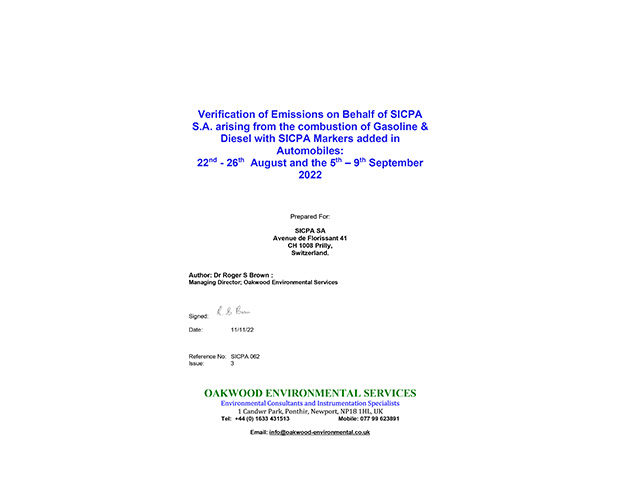
SICPA markers testing campaign was conducted under the supervision of Dr Roger S. Brown, an internationally recognized air‑quality scientist, Chairman of the UK Source Testing Association, and Fellow of the Royal Society of Chemistry (FRSC). The Source Testing Association (STA) has more than three decades of unparalleled leadership and dedication in the field of emission monitoring. Over the past 30 years, STA has significantly contributed to refining and establishing industry standards that have improved the accuracy, reliability, and safety of emission monitoring practices. Their advocacy for best practices and professional growth has empowered members with the knowledge and skills needed to excel in a rapidly evolving field. Dr Roger S. Brown’s input supports the conclusion that FIS does not result in measurable increases in regulated air pollutants or persistent organic pollutants compared with unmarked fuels. This clearly establishes that SICPA fuel markers can be deployed without compromising air quality, environmental protection objectives, or public health safeguards.

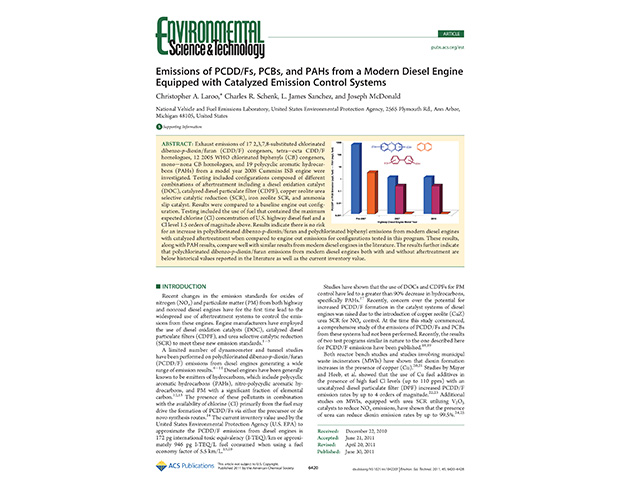
Similar studies on POPs emissions arising from the presence of halogenated compounds in fuels have been conducted by the United States Environmental Protection Agency and published in peer-reviewed scientific journals.
“Testing included the use of fuel that contained the maximum expected chlorine (Cl) concentration of U.S. highway diesel fuel and a Cl level 1.5 orders of magnitude above (10 ppm). Results indicate there is no risk for an increase in polychlorinated dibenzo-p-dioxin/furan and polychlorinated biphenyl emissions from modern diesel engines with catalyzed aftertreatment when compared to engine out emissions for configurations tested in this program.” (Environ. Sci. Technol. 2011, 45, 6420–6428)
This study, conducted entirely independently of SICPA by a highly reputable agency such as the EPA and reaching the same conclusions, with analogous methodology, lend even greater credibility to the rigorous studies carried out on SICPA’s fuel markers.
Reports – cover page:
Oakwood Environmental Services

Oakwood Environmental Services
Environmental Service & Technology


Challenges and needs

Solution overview

Benefits of the Fuel Integrity Solution

Case studies
FAQ
SICPA's Fuel Integrity Solution combines molecular fuel marking, field inspection and data monitoring to protect downstream fuel supply chains against tax evasion.
By introducing unalterable molecular fuel markers into specific fuel grades, authorities can conduct rapid field testing to immediately detect suspicious activities, combat fuel smuggling and adulteration, and strengthen supply chain oversight.
Forensic fuel marking provides clear proof of fuel identity and supports compliance monitoring throughout the distribution network, helping authorities verify compliance and identify potential diversion of subsidised.
A national Fuel Integrity Solution protects public revenues, defends consumers against substandard fuel variants, minimises environmental impact, and enhances transparency across the downstream petroleum sector.