From the Amazon to the world: how traceability, Digital Product Passports, and anti-counterfeiting build trust in sustainable products
Sustainability has become a defining priority for governments, brands, and consumers alike. Yet as sustainable products move across borders and value chains grow more complex, a critical question emerges: how can sustainability claims be trusted at scale?
Today, trust is no longer built on labels alone. It is built on verifiable data, secure technologies, and transparent systems that connect a product’s physical reality with its digital identity. This is where the convergence of traceability solutions, Digital Product Passports (DPPs), and anti-counterfeiting technologies is reshaping the future of sustainable trade.
Trust as the new currency of sustainable trade
Consumers increasingly want to know where products come from, how they are made, and whether they truly align with environmental and social values. Regulators, meanwhile, are tightening requirements to ensure that sustainability claims are accurate, auditable, and enforceable.
In this environment, sustainability is no longer just a brand promise – it is a measurable obligation. Transparency, traceability, and authenticity have become essential pillars for any organisation seeking long-term credibility in global markets.
ESPR and the rise of Digital Product Passports (DPPs)
The European Sustainable Products Regulation (ESPR) represents a major shift in how products are designed, marketed, and monitored throughout their lifecycle. At the heart of this regulation is the Digital Product Passport.
A DPP serves as a digital record that accompanies a product, containing structured and standardised information about its origin, materials, manufacturing processes, environmental impact, and end-of-life considerations. For regulators, DPPs enable oversight and enforcement. For businesses, they provide a framework for compliance and differentiation. For consumers, they offer unprecedented transparency.
However, a DPP is only as trustworthy as the data it contains – and as secure as the link between the digital record and the physical product.
Traceability beyond compliance
Traceability plays a foundational role in making DPPs meaningful. By capturing data at each stage of the value chain – from raw material sourcing to final distribution – traceability solutions provide the evidence needed to support sustainability claims.
Beyond regulatory compliance, traceability delivers broader value. It helps protect sovereign origin, ensuring that locally sourced materials and traditional craftsmanship are not misappropriated. It supports circular economy models by enabling reuse, repair, and recycling. And it strengthens supply chain resilience by increasing visibility and accountability.
For sustainable products derived from natural resources or vulnerable ecosystems, traceability is especially critical. It ensures that economic value flows back to legitimate producers and that environmental commitments are upheld.
Why sustainability needs anti-counterfeiting
While digital platforms and traceability systems provide transparency, they also introduce new risks. Without secure authentication, products can be copied, data can be falsified, and sustainability narratives can be exploited.
Counterfeiting does not only harm brands – it undermines sustainability itself. Fake products erode consumer trust, distort markets, and often rely on unregulated, environmentally harmful practices. In the context of DPPs, counterfeit goods can falsely appear compliant if physical-digital links are not protected.

This is why anti-counterfeiting solutions are a critical complement to traceability and DPPs. Secure features, overt and covert authentication elements, and tamper-resistant identifiers ensure that the product being scanned or inspected is genuine – and that its digital passport truly belongs to it.
Bridging the physical and the digital
The true power of modern sustainability solutions lies in bridging the physical and digital worlds. Secure labels, advanced optical features, and unique identifiers act as trusted gateways between a physical product and its digital data.
When combined with secure digital platforms, these technologies ensure data integrity throughout the product lifecycle. They enable instant verification by regulators, brand owners, and consumers alike, while protecting sensitive information from manipulation or misuse. This integrated approach transforms transparency from an abstract concept into a practical, scalable reality.
From the Amazon to the world: an Illustration in action
SICPA recently supported a sustainability initiative showcased at COP30 in Belém, highlighting the Amazon in the global climate agenda. The project featured trainers made from açaí seeds and natural rubber by Pará-based brand Seringô, worn by over 1,500 volunteers. This initiative demonstrates how forest-origin products can reach the public with full traceability, combining sustainability, transparency, and protection of sovereign origin.

The project was a global collaboration between Seringô, SICPA (Switzerland, América do Sul, Pakistan), and Lynx, integrating sustainable product innovation with authentication and traceability technologies. SICPA implemented a Digital Product Passport (DPP) for each trainer, aligned with the new ESPR European framework, ensuring proof of origin and product integrity. Using the QUAZAR® optical technology, each trainer features a secure seal with visual effects and a unique QR code, providing authentication, counterfeiting protection, and access to the product’s full journey from Amazon latex extraction to final manufacture.


Key highlights:
- Trainers made from açaí seeds and natural rubber, supporting sustainability.
- Over 1,500 volunteers at COP30 wore the trainers.
- Global collaboration for design, production, and authentication.
- Digital Product Passport (DPP) ensures traceability and regulatory compliance.
- QUAZAR® secure seal protects against counterfeiting and showcases brand values.

While just one example, it highlights the broader potential of integrated solutions to enable responsible trade across sectors and geographies.
Value for the entire ecosystem
The convergence of traceability, DPPs, and anti-counterfeiting delivers value across the entire ecosystem: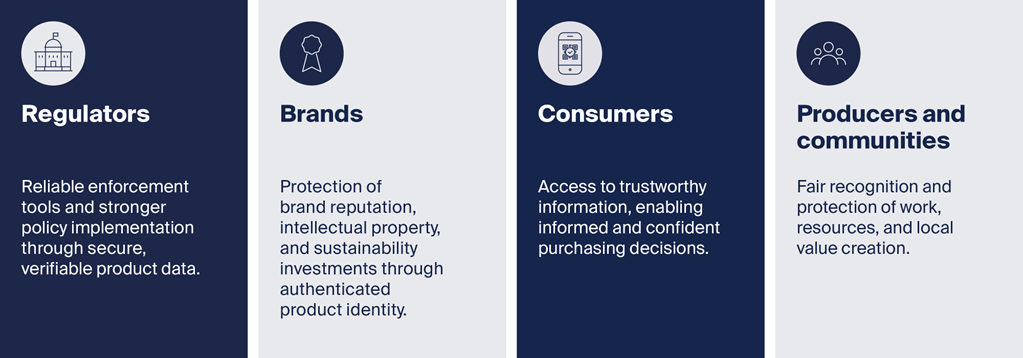
• Regulators gain reliable tools for enforcement and policy implementation.
• Brands protect their reputation, intellectual property, and sustainability investments.
• Consumers access trustworthy information and make informed choices.
• Producers and communities see their work and resources fairly recognised and protected.
By aligning transparency with security, these solutions create a shared foundation of trust.
Building the future of trusted sustainable markets
As sustainability regulations evolve and consumer expectations rise, isolated solutions will no longer be sufficient. The future belongs to integrated systems that combine secure physical authentication with robust digital traceability and regulatory-aligned data frameworks.
At SICPA, this vision is rooted in decades of experience protecting value, identity, and trust. By applying world-class authentication technologies alongside advanced traceability and digital solutions, SICPA supports governments and brands in building transparent, compliant, and resilient value chains.
Transparency that protects what matters
Sustainable trade depends on more than good intentions – it depends on proof. By uniting traceability, Digital Product Passports, and anti-counterfeiting solutions, organisations can ensure that sustainability claims are credible, compliance is achievable, and value is protected from source to consumer.
From the Amazon to global markets and beyond, trusted transparency is the key to safeguarding resources, empowering communities, and shaping a more responsible global economy.
Read the latest articles on Product and Brand Protection